How Richfield Supports Reliable International Sourcing
Quality Is More Than Appearance
When purchasing freeze-dried fruit, buyers naturally look at color, flavor, aroma, shape, and price. However, long-term supply depends on a much wider quality-management system. Raw-material control, process hygiene, foreign-material prevention, microbiological standards, chemical-residue limits, packaging integrity, traceability, documentation, and batch consistency all affect whether the product can be used safely and efficiently. Shanghai Richfield International Trade Co., Ltd. treats these factors as essential parts of every commercial project.
Freeze-dried fruit is made from agricultural raw materials, so natural variation cannot be eliminated completely. Color and sweetness may change with variety, harvest period, climate, and growing region. A professional supplier therefore needs to distinguish between acceptable natural variation and actual quality defects. Richfield works with customers to define measurable requirements and practical tolerances before bulk production, reducing misunderstandings during inspection and delivery.
Control Begins with the Raw Material
The finished product can only be as good as the fruit entering the factory. Incoming materials are evaluated for freshness, maturity, color, flavor, size, physical damage, decay, and foreign matter. Depending on the fruit and intended market, additional requirements may relate to pesticide use, agricultural practices, or specific origin information. Unsuitable fruit is removed before processing.
The raw material then passes through washing, sorting, trimming, peeling, pitting, coring, cutting, or other preparation stages. Hygiene controls are important because the freeze-drying process is designed primarily to remove moisture rather than to replace all food-safety controls. Clean equipment, controlled personnel practices, approved water, environmental sanitation, and appropriate handling procedures are needed throughout production.
Process and Foreign-Material Management
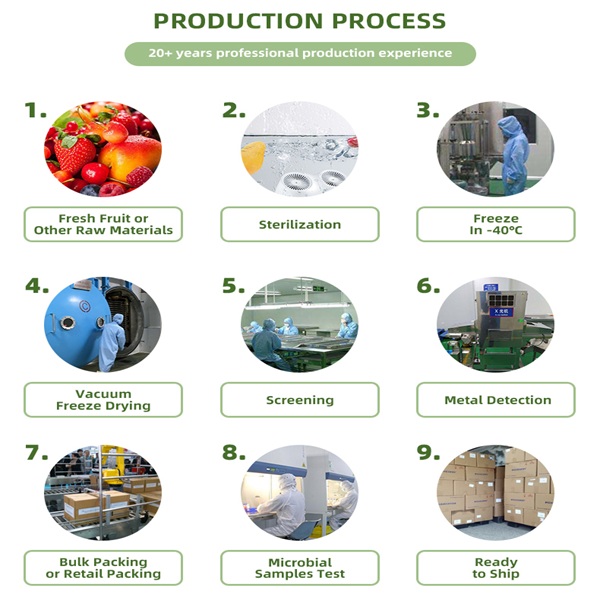
During production, critical parameters such as freezing conditions, vacuum level, drying time, temperature, and final moisture are controlled according to the product. After drying, the fruit is inspected and classified. Depending on the line and risk assessment, foreign-material controls may include screens, sieves, magnets, air separation, manual sorting, optical sorting, metal detection, and X-ray inspection. These controls are designed to reduce the risk of stones, metal, dense foreign bodies, plant material, or other unwanted objects reaching the final product.
Packaging areas require particularly careful moisture control because freeze-dried fruit absorbs humidity quickly. The product should be packed promptly in suitable high-barrier materials and sealed correctly. Seal integrity, inner-bag condition, carton strength, labeling accuracy, and case configuration are reviewed before shipment. Storage conditions must also protect the product from heat, moisture, odors, pests, and physical damage.
Testing and Customer-Specific Standards
Different customers and markets may require different analytical standards. Common checks include moisture, water activity, sensory characteristics, particle size, bulk density, microbiological parameters, pesticide residues, heavy metals, allergens, and nutritional values. Customers may also request tests for specific pathogens or contaminants based on their internal policies and destination-market regulations.
Richfield helps coordinate appropriate testing and communicates the agreed requirements to the production side. A certificate of analysis may be provided for commercial batches according to the contract and specification. Where third-party testing is requested, the scope, laboratory, sample method, and timing should be confirmed in advance so that results are relevant and accepted by the customer.
Documentation and Approval Support
For international food companies, technical documentation can be as important as the physical sample. A supplier may be asked to complete product information forms, material assessment documents, HACCP questionnaires, allergen declarations, GMO statements, naturalness declarations, origin statements, process flow charts, ingredient data sheets, packaging questionnaires, sustainability forms, or supplier warranties. Each customer may use a different format and approval workflow.
Richfield has experience supporting this documentation process. The company collects information from factories, reviews customer templates, coordinates signatures and company stamps where required, and follows up on missing items. It also assists with export documents, sample-shipment paperwork, and communication with couriers or logistics providers. This administrative support reduces the workload for customers and helps prevent delays in supplier approval.
Traceability, Consistency, and Continuous Improvement
Traceability is necessary for effective food-safety management. Commercial shipments should be linked to production dates, batch codes, raw-material information, inspection records, and packaging records. If a customer raises a concern, clear traceability allows the supplier to investigate the relevant batch and respond with evidence rather than assumptions.
Batch consistency is managed through specifications, approved samples, production controls, and final inspection. Because freeze-dried fruit can be fragile, agreed limits for breakage, powder, size variation, and color should be realistic and application-based. Richfield encourages customers to evaluate samples in their actual production process whenever possible.
The company’s objective is not only to pass an initial audit or complete a questionnaire, but to build a reliable supply relationship. Feedback from customer trials, complaints, and market performance is shared with the relevant teams so that products and procedures can be improved. Through clear standards, risk-based controls, complete documentation, and responsive communication, Shanghai Richfield supports food manufacturers and brands seeking a dependable source of freeze-dried fruit for international markets.
Post time: Jul-17-2026